
Click for caption
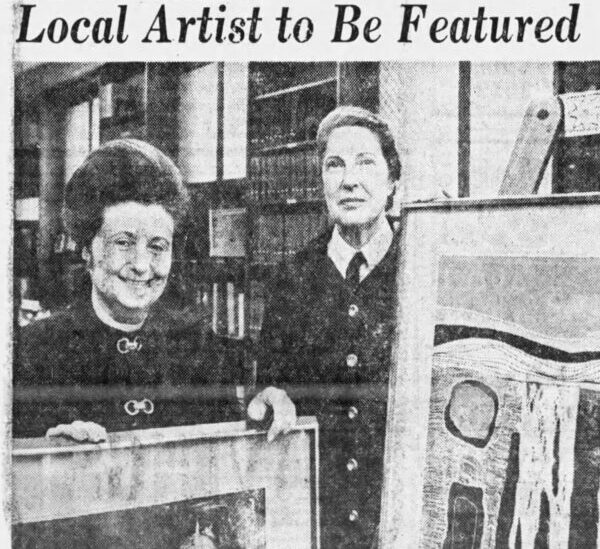
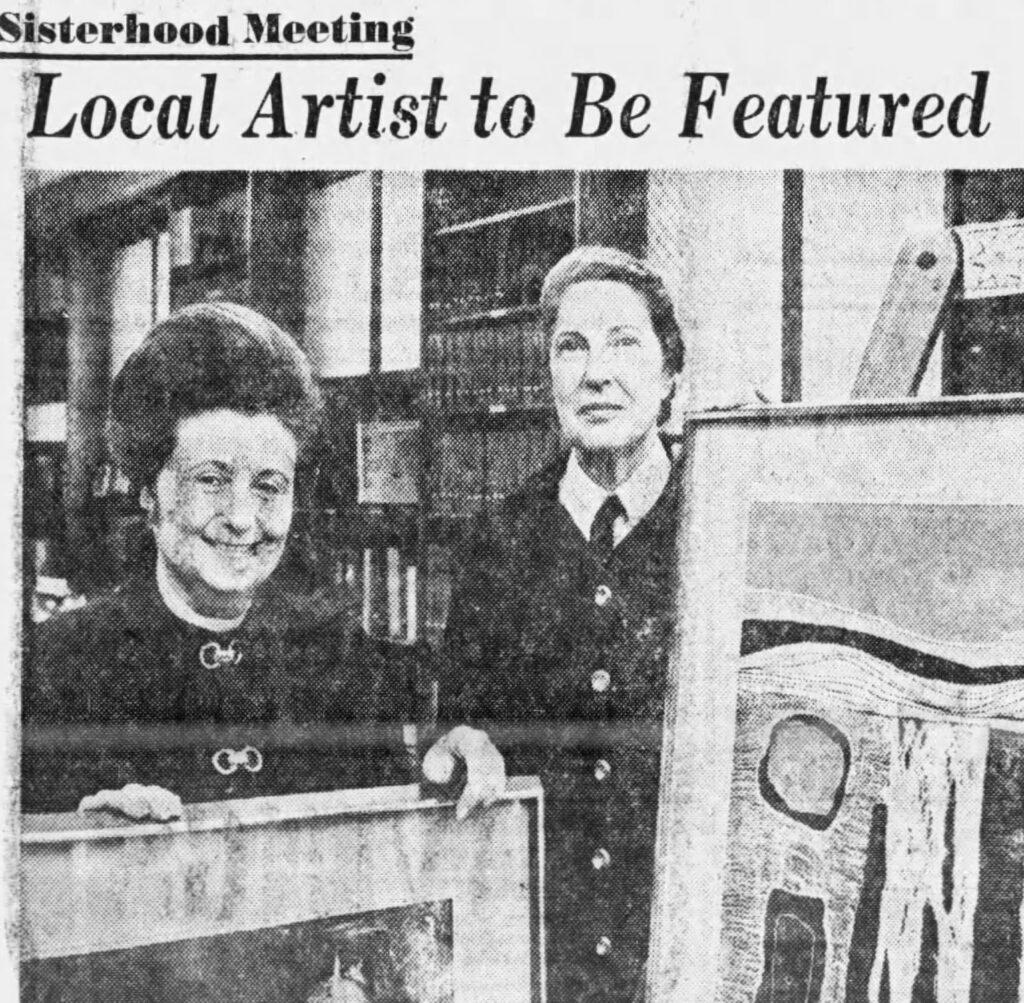
Photo from the Hartford Courant (Hartford, CT) archives, April 8, 1972: “Local artist Margot Rosenthal, left, shows Mrs. S. Burr Leikind, Temple Beth Israel Sisterhood president, some of her works in preparing for a discussion and demonstration on “How to Look at Art”.
Born in Berlin, Germany, Margot Rosenthal began her artistic journey 100 miles away in Dresden, Germany, when at age six she and her mother relocated to be with family while her father served in the army during WWI.
In a 1987 Oral History interview for the Jewish Historical Society, Margot talked about her interest in art beginning in childhood calling it her “favorite subject in school”. With her growing love of art, particularly painting, Margot attended a private art academy after high school, where she” got her first training.” Leading her along this artistic pathway, she described an artistic family environment influenced by aunts who were naturally talented painters and her mother a self-taught amateur landscape and nature photographer. She explained learning photography by just being exposed to it. “My mother did very beautiful photography and had her own darkroom. We traveled a lot, and we did do a lot of photography on our trips.” Inspired to pursue photography and painting, these two mediums were the impetus that launched an artistic calling that remained throughout her life.
At that time (1937) it was still possible to emigrate to the U.S. without knowing anyone in the country, and if you showed possession of $5,000 you could come in
With the rise of Hitler in the early 1930s, Margot recalled that she and her husband faced the realization that it was becoming impossible to make a living. Her husband, Dr. Ernest Rosenthal, an ophthalmologist in Chemnitz, Germany, was no longer allowed to practice medicine, which necessitated their move to the United States in 1937. She explained that “at that time it was still possible to emigrate to the U.S. without knowing anyone in the country, and if you showed possession of $5,000 you could come in.”
With a short stint living in New York City, the couple was encouraged by a medical school friend to relocate to Hartford, CT, which they did. With the hurdle of Dr. Rosenthal passing the Connecticut medical license exam completed, they were eager to settle into the community to begin their new life. Margot pressed the fact that although the effects of the Depression, causing unwelcomed competition among physicians, and the antisemitic housing and social incidents they encountered that “coming from Germany, we were already so conditioned to this attitude that it didn’t really affect us.” Disregarding these community prejudices, Dr. Rosenthal became a prominent ophthalmologist in the community, establishing a state-of-the-art successful private practice, along with a Yale University Medical School assistant professorship and as chief of ophthalmology at Mount Sinai Hospital, Hartford, CT.
Margot soon began to make a name for herself as well: armed with her Rolleiflex camera. With the art of photography second nature to Margot, she serendipitously noticed a “terribly stiff formal portrait” of a friend’s one-year old daughter. Suggesting that she “thought she could do better than that”, asked if she could take some pictures of the child. Using Elizabeth Park as a backdrop, she photographed the child playing, capturing the little girl’s unique childhood personality with a different, more captivating technique.
Happy with the result, her friend’s referral to Mrs. Ruth Ribicoff, wife of renowned politician Abraham Ribicoff, CT state legislator at the time, was key to kicking off Margot’s career as a professional photographer. Upon photographing the Ribicoff’s young son, Peter, Margot recalls Mrs. Ribicoff telling her, “If you want to do this, you have to charge for it.” Taking this advice Margot established her photography business, traveling from home to home. She soon became the photographer-in-demand for some of the most prominent families in Greater Hartford. She was known for her unique artistry and her innovative method of presenting the prints as an accordion booklet. Many years later, her legacy as a children’s photographer endured as she put it: “I have the shock of my life when a middle-aged person asks, do you remember me? I go, you’re one of my babies.”
Margot reveals in her interview that although she was focused on her children’s photography business for 25 years, she started to paint again while teaching her eleven-old son to watercolor while vacationing in the artist colony of Rockport, MA. “I started to paint too. We did watercolors and I got really interested in it again. And I never stopped.”
Pursuing her desire to continue painting, Margot, joined a group of friends taking evening classes at the Hartford Jewish Community Center with Dorothy Segal, a well-known Hartford-based Jewish artist whose works were exhibited and part of permanent collections in museums throughout the Northeast. Building upon her five-plus-years-experience painting only in oils with Dorothy Segal, Margot moved on in 1958 to study with Paul Zimmerman, an internationally recognized watercolor and oil landscape artist and faculty member at the Hartford Art School. (Hartford Art School, founded in 1877 by a group of prominent Hartford women, was one of three local educational institutions that merged in 1957 to form the University of Hartford.)
Remembering the six years spent under Zimmerman’s tutelage, Margot joyfully expressed that they had a “fantastic class, hitting him at his best teaching period.” She continued to say that Zimmerman told them, “I don’t think there’s ever been a class like this.” According to Margot, the experience resulted in most of the class members becoming professional artists, who forged life-long friendships. Describing this “marvelous” relationship among her peers, she said in 1987, “we still work together, we support each other, we criticize each other’s work, we help each other.”
Like other situations in Margot’s life when circumstances directed her path, her next move as an artist came in 1964 while recuperating for one year from hip surgery making standing while painting impossible. Always interested in adding texture to her oil paintings by throwing in sand and “all kinds of things”, Margot began to dedicate her artistic focus solely on collage “in any form you can think of.” In her 1987 interview she exclaimed that “even after 24 years, I’m still fascinated with the medium. I think I’ve developed my own style in collage, doing collage as a landscape.” In creating her signature collage approach, she explained, “I think this is really what I have personally invented and arrived at and nobody approaches collage from that angle. That’s strictly my own thing.” Part of her unique technique is her proclaimed love of earth tones, which Margot explains is the reason behind her use of a very limited color palette, consisting of blues, rusts, brown, beige, silver, gray and black. Although focused on her own approach, she also recounted creating collages utilizing techniques conceived by such artists as Picasso, Georges Braque, Matisse, and other notable collage artists that she “loves”.
During this time Margot’s work started to sell and her prominence in the art world community began to grow. Her professional life began to fill with corporate and private collector commissions, along with prestigious juried art gallery shows and museum exhibitions in the Northeast region and nationally. Throughout her life Margot received numerous accolades for her work and among them are 46 prize-winning awards. A notable honor was the acquisition of a Margot Rosenthal seascape made by the nationally renowned New Britain (Connecticut) Museum of American Art and became part of the museum’s permanent collection. As her stature and recognition in the artist community rose, Margot assumed leadership roles as president of Connecticut Women Artists and as a board member of the Connecticut Academy of Fine Arts and the Connecticut Watercolor Society and was a valued member of many local and regional arts organizations.
Willing to share her years of experience experimenting with and perfecting her innovative techniques with a variety of art mediums, Margot began her teaching career. She was on the faculty at the West Hartford Art League and the Hartford Jewish Community Center. For more than 25 years she taught advance painting and collage, while still working as an artist. She was proud to claim in a 1992 speaking engagement at Temple Beth El, West Hartford, CT, that she “graduated a lot of now very well-known artists – with some of them in the room – and it was a great pleasure that she enjoyed very much.” That sentiment was reciprocated by her students. In a 2010 Hartford Courant interview with Margot’s son, Stephen Rosenthal, shortly after her death, he fondly tells how she was so “adored by friends, and especially her students.” He added, “many people thought she was wonderful. They were so loyal to her.”
Reflecting on her achievements as an artist, Margot proclaimed that in Germany you could not just declare: “I’m a photographer. I am a painter. You needed permission for it to be.” In the United States, her pursuit as an artist, moving in self-chosen directions, Margot declared that she was able to become, “a person for myself, finally. And it feels very good. And I’ve enjoyed it. I’ve done it tremendously. And I really think that I had a happy and a good life, and I was one of the lucky ones.”