
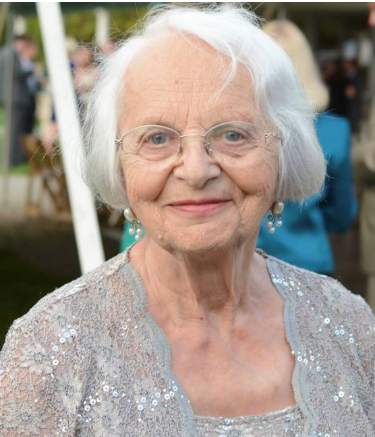
For many years, Eve Soumerai, known to the greater Hartford community for her human rights advocacy as an educator, poet, and photographer, made life-long impressions on adults and children alike. Born Eva Nussbaum, her story begins in 1926 Germany where she enjoyed a happy, carefree childhood with her parents and younger brother in a welcoming, integrated neighborhood. She pointed out in a 1980 interview as part of the Jewish Historical Society’s Oral History Initiative, that she was growing up with an awareness that people with different beliefs and culture could live together harmoniously. “It was rather pleasant, she said, but added “then things changed.” In 1935, Eve explained that there was pressure on parents not to let their children play with their Jewish friends. She recalls a heartbreaking scene when her childhood friend’s tearful mother felt it best they not play together for the time being, thinking it was only temporary.
As the situation worsened in Germany, with her father being rounded up, arrested and spending time in prison and afterward not allowed most types of employment, new neighbors acting as spies, and experiencing hateful acts daily, it was imperative they get out.
Finally, with the realization that “things are pretty bad,” Eve’s father “tried to get his two children out, just in case he didn’t make it,” she said. Recalling that fateful time in her life, Eve said, “In my case there were two families who wanted me as a girl, little girl. Nobody wanted a boy and not a woman, So I had two and he had none.” She passionately emphasized during her interview that the real help at this time was given by private organizations and individuals. Help through government channels was limited with the real impetus coming from private sectors. “Unless you have individuals in any given situation do something about anything, it’s never going to happen,” she exclaimed.
At the age of 13, Eve was one of 10,000 refugee German children welcomed to the United Kingdom as part of the Kindertransport a few months before the start of the war. This was the result of the British House of Commons passing a law on November 21, 1938, allowing them entry as refugees. Looking back on her early life prior to the war, she said, “on the whole I didn’t know what unhappiness was. But until I got to England as a refugee, I didn’t really know what unhappiness was.”
Eve’s experience has a child refugee shaped her views about her roots, the world’s morality and her place in it.
As a young teen refugee in England, drastically uprooted from her loving parents and “best-friend” brother Norbert, along with all that was familiar, Eve recalled experiencing overwhelming loneliness and sadness, missing the vibrant, safe life she knew. These feelings were compounded with living in a very strict foster household with little freedoms. Drawing strength from knowing her father had faith in her and in his ability to find joy in any circumstance, Eve created a new, personal world for herself. Consisting of “reading, thinking, imagining, and talking to the moon shining through her bedroom window,” Eve said it helped “pull her through” the debilitating world she was experiencing. She also took solace and encouragement from her mother’s poetic last words to her: “look at the stars and pray.”
During her formative teen years into young adulthood, Eve began her quest to understand what was happening in the world. She asked why was there so much injustice and oppression, why so much hatred, and what could be done about it. She knew that her grandparents and parents believed that morality existed despite their life experiences with the horrific rise of Nazi Germany and the subsequent atrocities committed around the world during WWII. She read stories of people who had overcome injustices and felt the need to connect with people who could help her better understand what was going on in the world.
In her determination to understand why injustice and oppression existed and how to overcome such debilitating human experiences, she forged her lifelong path, beginning at age fifteen. This is when Eve, using her current life experiences as a young refugee, volunteered to help displaced children who had been separated from their parents during the London Blitz. At 16 years old, committed to help children facing wartime hardships, Eve was asked to work with renowned English pediatrician and child psychiatrist, Dr. Donald Winnicott at a London children’s hospital. These endeavors caught the attention of child psychoanalyst Anna Freud, resulting in interviewing Eve as part of her research on the impact of war on children.
Shortly after the war in 1945 and by lying about her age she was able to secure a position as an allied civilian employee for the U.S. Army and returned to Germany. While her workday assignments included translating documents that detailed hiding places of SS officers and locations of hidden artwork and serving as an interpreter, her days off were quite different.
In an interview with the Hartford Courant, Hartford, CT, January 17, 1993, Eve said that on weekends, “she tried to make sense of the Holocaust.” She added, “that if she could not do that, she vowed to find ways to use it as a lesson to change attitudes of young people to make them more sensitive in dealing with human beings.” And that she did.
Married at 19 years old to Henri Soumerai, a Swiss engineer, the couple emigrated to the United States in 1950, first settling in Massachusetts and then West Hartford, Connecticut some ten years later. It was here, in her adopted country that for 70 years, Eve brought together school children from diverse backgrounds to learn about individuals who have overcome injustices and inspired renewed hope for the goodness of humanity.
Thirty of those years she taught in West Hartford, CT schools where she developed, advocated and introduced a landmark human rights component be included in the curriculum. The impetus, she explained in the 1993 Hartford Courant interview, was her discovery that only two of 360 students attending her guest lecture in an area school knew about the Nazi genocide.
Her enrichment program proposal included a series of overall themes encompassing civil rights, diversity, equity and inclusion. Through research, interviews and outreach activities, students would examine human rights of individuals who experience discrimination based on age, mental illness, disabilities, homelessness and those affected by HIV/AIDS epidemic, explore the nature of prejudice and its effects on people, investigate the roots of the Holocaust, Apartheid and dissect the “art of propaganda” used by Hitler. Among the historical icons Eve introduced to her students were Martin Luther King, Jr., Roberto Clemente, Nelson Mandela, Anne Frank and Langston Hughes, a renown American poet, social activist, playwright, novelist and columnist. Studying the lives, accomplishments and legacies of these individuals taught Eve’s students that working to change pre-disposed prejudicial perceptions that result in discriminatory attitudes and conduct could produce a population that is kinder, more thoughtful and accepting of differences.
With the approval in hand, Eve implemented the centerpiece of her human rights enrichment plan which she called “Tributes.” Upon researching human rights advocates students also had the opportunity to “walk in their shoes.” They became playwrights and wrote scripts based on what they learned and then brought them to life with theatrical presentations paying tribute to famous historical figures.
The Tributes contributed greatly to Eve’s desire and life goal to bring together people, particularly school-age children and adolescents from different communities, cultures and faiths to learn about each other, to engage in discussions of morality and tolerance. Her family so eloquently wrote in her obituary that “she believed in the power of kindness and laughter to bring people together and she tried to make every person she met believe they had the courage, the character and capacity to be a leader for social justice.”
Over the years, Eve received community, state and national recognition for her life-long work. Commendations came from Connecticut leaders including then Connecticut Governor, John Rowland issuing a 1999 “proclamation honoring her lifetime contributions to education “, and then U.S. Senator Christpher Dodd and U.S. Senator Joseph Lieberman, who wrote: “Eve’s work transcends the story of the Holocaust, her teachings reinforce the notion that we are all members of a larger community and the forces that bind us are much stronger than the forces that seek to tear us apart.”
The most telling of Eve’s legacy are those colleagues who worked with her every day sharing her vision and helping to bring it to life and those students who took her classes, participated in her Tributes and learned about human rights and their role in the world. As a mentor of a young teacher, Eve is remembered as an inspiration and how she treated all people with respect and dignity with other former colleagues reminiscing about her infectious energy to do good in a difficult world, calling her vibrant and compassionate. Decades later, former students recall her energy, enthusiasm and passion for the Tributes, with one West Hartford resident recalling taking her class on the Holocaust and being encouraged to play Macbeth in a Shakespeare Tribute. For all those who knew her and describe what she meant to them, their last words are always: “I will never forget her.”